
10 Brilliant Ideas on Writing and Work

I was lucky enough to find a writing coach and editor in the early part of my career who invested in me, let me borrow his books, and nurtured my curiosity about all things writing, editing, and publishing. Over the years, I’ve developed a wide network of writer/editor friends with whom I’ve received and exchanged […]
Communications & Systems Change

This piece was originally published at The Outside in May 2019. After working with Tuesday Ryan-Hart and Tim Merry and the team at The Outside on a few change projects this year, I joined Tuesday and Tim to co-write this piece on why a systems change approach to communications matters. Communications work is a vital piece of […]
Lessons from Alison Hawthorne Deming and Sarah Schulman on hope and organizing during a “disturbance regime”

These are just two threads of learning that I took away from Social Justice Week at Fine Arts Work Center in July 2018 among many, many, many. If you were there as well and have reflections, please add your learning and thoughts in the comments. During Social Justice Week at Fine Arts Work Center in Provincetown, Massachusetts […]
Flip the Pattern of Erasing Women, Give Women Credit for their Work Every Chance You Get

“The only way you learn how to flip things is to just flip them.” – Julia Child Why does it matter when you use someone else’s work without giving them credit? Especially a woman’s work? Until recently, I didn’t hear much about this problem for whatever reason. Then all of a sudden I felt like […]
Three Ideas to Help us Build the Feminist Businesses of the Future

On April 28th, CV and I were delighted to partner with Petra Kassun-Mutch, creator of Liisbeth, a consistently excellent magazine for feminists in business, and Dr. Barbara Orser, Professor of Management in the Telfer School of Management, University of Ottawa and co-author of Feminine Capital, on a workshop dedicated to feminist business practice at the Centre for Social Innovation in downtown Toronto. View photos from the event here.
Petra gathered all of us together, welcoming entrepreneurs, academics, and other changemakers to CSI for a day of learning. Barbara opened the day with a keynote looking at the hard truth about the state of women’s entrepreneurship (and funding/capital) in Canada, summarizing key findings from her book, and making a case for “entrepreneurial feminism”. And then CV debuted her Feminist Business Model Canvas (FBMC), a Feminists at Work tool, which among other things, helps entrepreneurs build the businesses of the future by working with feminist values and generative design principles.
How We Benefit from Women-Led Systems of Influence
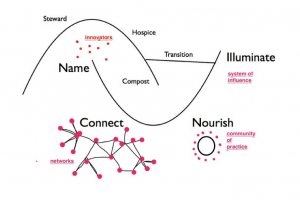
There’s a difference between women stepping up into leadership and women stepping up into leadership together. I’m infinitely more interested in the latter because it means finding ways to work together while allowing for deep points of difference. It also means creating new knowledge together, which is energizing for everyone. My first real foray into […]
What to do when collaboration reproduces hierarchy and inequality
There may be nothing new under the sun, but things get forgotten or go unresolved. Patterns get played out over and over again in ways we can’t see. One repeating stuck pattern I see in even the most well-meaning, collaborative circles is gender bias.
We know that gender bias takes a personal and economic toll on individuals. But gender bias has collective negative effects which mostly get ignored. Too many good ideas with the potential to move communities, organizations, entire fields forward get lost simply because they happen to come from women. Too many good ideas only get heard when they are picked up by men (who don’t always give women colleagues credit) and much gets lost in translation. All of this is compounded by race and class.
If we know this happens, one outcome is that we struggle to follow a woman’s lead when it comes to doing things differently. We struggle to move from knowledge to practice and to women-led practice.
The Different Life Trajectories of Women-Led Startups
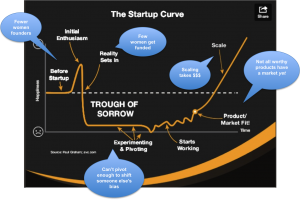
The problem when you leave a gender equity lens out of entrepreneurship or business development isn’t that men don’t create good businesses; to echo Buffett, it’s that you create the conditions for essentially wasting half the world’s talent. You stop businesses from being the best they can be, you stop ideas that happen to come from women before they get off the ground.
There’s a Conversation Brewing About Power that Needs #MoreVoices

How do we practice new power behaviors at work (in our for-profit and nonprofit organizations and in the way we interact with each other)? What can women and other marginalized groups bring to this conversation that help move this conversation along so it has its greatest impact? How do we make visible work that historically has been made invisible or devalued?
Women Would Be Crazy to Lead (Lead Anyway)

There’s the cult of productivity ethic that tells you to do more, always more, for who knows what reason, often to your detriment. And then there’s going out and doing what you really want to do as a human being on this planet, day to day and in the long-term. These are different things.


